skip to main |
skip to sidebar
 On the same trip out to Nagano at the start of March, we veered into a northerly direction and headed towards Matsumoto Castle. It's a spectacularly well-preserved castle that managed to escape the fate of being demolished and sold for parts at least twice. I believe some parts of the roof and other ornaments are considered a National Treasure (by 'considered' I mean, it is labelled and officially documented as such). One of it's nicknames is Crow Castle since it looks so black. The original castle and all it's land encompassed pretty much all of Matsumoto city. Now, Only the Castle and grounds up until the innermost moat have survived.
When you purchase your ticket, you get admission into the Castle grounds and into the castle itself. To help preserve the Castle floors, which are made of cedar wood, you must remove your shoes, place them in a plastic bag, and carry them with you through the entire tour. They provide you with one-size-fits-all slippers. Normally, this wouldn't bother me. However, some of those ladders (which they called 'stairs') were so steep they may as well have zero incline. And the gap between each rung... I've done stairmaster exercises that were almost as difficult. Add to the mix, the winter boots that I was carrying, as well as the 1.5 kg camera and accessories, all the open windows in the middle of winter, and the slippers flip-flopping off my small sized feet... and it makes for a somewhat uncomfortable tour. We went at our own pace, but I notice that the taller people in the group wanted out as soon as possible. All ceilings were low and the space was tight.
The uncomfortable aspects aside, it WAS a well preserved castle from the height of the samurai era. Everything just felt so old. There was surprisingly few creaky sounds for the age of the wood. The quality of the wood of the castle is evident.
I have posted my favourite outside view from the day. There were also 2 swans in the moat. I don't know how they got there, and they weren't visible at the start of the tour, but I managed to get a fairly closeup angle on one. Both photos were shrunk for easier uploading.

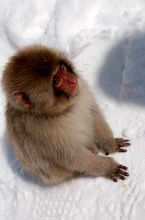
 One of my favourite trips was the trip out to Nagano where the famous snow monkey onsen exists. These monkeys are native only to Japan and have been featured on the cover of National Geographic and Discovery magazines before. They naturally have a bright pink face; no enhancement was done to this photo (the photo was shrunk to make uploading online easier).
The park is nestled in the monkeys' natural habitat in a small valley with a stream running through it and a small onsen where the monkeys love to gather in the coldest months of the year. We joined an English speaking tour group for this one. Normally, I like the flexibility of driving and controlling where we go and when we go. However, in Japan, you drive on the wrong side of the road (that's right, the left) and the toll fees to get to Nagano and back cost a small fortune. In the end, it was easiest to go with a group and I'm glad we did.
Jigokudani monkey onsen is not a field trip for the faint of heart. You can only drive up to the middle of the mountain and then park. In January and February, the choice parking spots are usually all taken, thus forcing you to park lower on the mountain. Once you park your vehicle, it's about a 10 minute walk to get to the lake, which gets you to the foot of yet another mountain with a rail-thin pathway to get to the park. At this junction, there is also a bridge going leftward toward an onsen for humans. Before you cross the bridge, there is a huge geiser that spits up water to about the 5 floors high. You don't go left and cross the bridge; you turn right and face a 2 storey sets of stairs. After climbing this set of steep-ish stairs, you have another 15 minute walk on a thin snow covered pathway with no railings, which I wouldn't exactly call child- friendly. Enroute, if you pass people returning from the snow monkey onsen park, usually one group has to step aside as the path really is that narrow in most places. If you are afraid of heights, don't look to your left as you make your way to the entrance. There are plenty of signs to help you get there. If you can't read Japanese, signage in English abounds, as do the pictures of monkeys, so you really can't miss it.
I don't recall the price of admission. Less than $10USD for sure, but for us it was included in the price of the tour. Once you pass the admission hut, it's another 5 minute walk on narrow snow covered pathways to get to the onsen, river and small bridge to get in front of the small waterfalls (nothing like Niagara Falls, but a small wonder all the same). Here is where you can get your best photos of the adorable little creatures. Once you have passed the admission point, the monkeys start approaching you in small groups. When you reach the bridge to get to the Onsen on the other side of the valley, you can't turn your head without catching a glimpse of one; they're everywhere at this point. At first, I kept the camera close at hand kept clicking without achieving the perfect conditions... then when I realized that there would be plenty of opportunities to take some cute snapshots, I slowed down a bit. You don't even have to go to them - they come to you.
I have posted one of my favourite posts from the day. We went at the start of March. The snow had already started to melt, even in the mountains of Nagano. Most of the monkeys seemed to be warm enough without having to jump into the Onsen. Jigokudani means "hell valley". It was such a memorable experience. If you get a chance - you should definitely go.