skip to main |
skip to sidebar
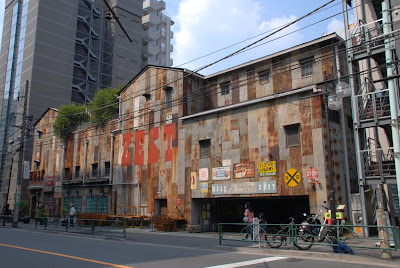 We go to this restaurant all the time. It got Tex-Mex food ... but with a Japanese twist. I notice that the restaurants here like to do that --- put their own twist on old favourites. Although, this restaurant does indeed change the original recipes to suit the local tastes, this particular restaurant is a gem amongst Japanesified western restaurants. It's spacious for one thing. And it's solidly built; the inside support beams will attest to the solid foundation of this building. The food is true remind-you-of-home comfort food. The outside doesn't look like much but it's going for the Old West abondoned look. The restaurant is called Zest and apparently, it has about half a dozen locations around Tokyo. The newest addition can be found in Hiroo, but that location only has burgers and none of the other Tex-Mex food items on the Ebisu menu. I haven't been to the other locations to test out their food or question their waitstaff, but I do frequent this one regularly.
I know that during the weeks, for lunch, they have English speaking waitstaff and the manager speaks English very well, but by his accent, I would guess him to be of Hispanic language origin. Most of the other staff are Japanese, but are super friendly. They are always willing to accommodate your special needs. If you order the beef steak jambalaya, they actually will cut up the egg (they like to put fried, sunny-side eggs on everything here) and mix it up in your rice jambalaya dish for you. Once we sat beside a rather large party for brunch on the weekend and we saw their spicy chicken wings being mixed up right there in front of them at their table. Since they ordered what seemed to be a rather large amount of wings, this table required 2 waitstaff to mix up the wings for them. They sang a song while they were mixing.
On most weekends that we've been by, the first floor has been rented for private parties, but the 3rd floor is open. On those days, the hostess will greet you at the front entrance, but direct you to the elevator within the garage so that you can get to the 3rd floor.
All floors are spacious. I never feel like I'm cramped between tables. And for all the tall people out there, the ceilings are also high. The lifts are small-ish as is the standard here in Japan.
I don't work for the place and the restaurant didn't pay me to write about them. I just love going because, except for the Japanese staff, and the location, it's mostly a western feel and reasonable lunch fare prices.
 I guess it's been a while since I last blogged here. It's been a busy month. Those intensive Nihongo classes really take up a lot of time in the most unexpected ways.
Speaking of Nihongo classes, I just took my classmates to one of my favourite yakiniku type places in Tokyo, Negishi. I've only ever been the Shibuya branch, but there's apparently one in Shinjuku and one other large neighbourhood as well. We went to the one in Shibuya as it's just a stone's throw from the school.
Upon first glance at the relatively simple menu, they thought the prices were rather high for what you were getting. But after one bite, they were converts. They, like me, think the food there is fantastic. The meat there is done well and the sauces are spiced up nicely. We each ordered a set different menu course and sampled from each other's plates. Although, the tororo soup, the pork soup stock, rice mixed with oats, and the pickled veggies seemed to be staples for almost every dish, so there was really no need to share those ones.
Here's a close up of our various dishes:

 Access to the one in Shibuya:
1. get to Shibuya eki on any line and get to the Hachiko exit
2. walk up the street that's got the 109 on the right and the Tsutaya with the Starbuck on the left; make sure you are on the same side as the Tsutaya record store.
3. When you get to the cross street with the 2 Marui Department stores (logo is 0101 in large red and white) cross in a straight line towards the one that has a MacDonald's at the bottom. The other Marui should be visible to your right.
4. Once you pass that intersection, turn left and the Marui with the MacDonald's should now be on your right.
5. Walk about 2 small blocks and look to your right and down into a stairway going to a basement restaurant. That's Negishi. It is just passed an Excelsior Cafe shop. Across the street diagonally, you will see the Parco Department store. If you hit a Denny's on your right, you've gone too far.
Good luck. It's well worth the effort. My set menu with 2 kinds of bar-b-q meat and sauces and other side dishes was about 1400 yen. My friend had the stew and 2 side dishes and that was 1200 yen. You can get a set meal for 800 with a single type of meat (pork or beef) and one flavour.
I had heard about "darui" a few months back while studying some Japanese. It's a word associated with the summer months because Japanese summers are so 'mushiatsui'. This means hot AND HUMID. Notice the stress on the HUMID part. The apparent Japanese cure for thes e summer blues is eating unagi. For the uninitiated, this is eel. Apparently eating eels will strengthen your resolve and relieve you of that drained, constantly tired, always parched feeling. This summer, there are two officials days of unagi eating: today and and next week August 4th. These are the predicted peak days of feeling so drained that you have no strength and no will to move. Officially, these two days are called 'natsu no doyou no ushi no hi'. Loosely translated, this means "the day of summer's dog days of (cows?)". Hmmm... the translation seems to break down for me here, but after doing a basic search online, it seems that I'm right. I guess a better translation would be something like: the day to fortify yourself during summer's hottest days. FYI, the cow/ox is the zodiac's workhorse animal and symbolizes having the strength to finish difficult tasks. I'm a cow. Read into that what you will.
In Canada, the summers might have 3 or 4 days where the temperature is really high, but maybe not that humid. On these days, there are public service announcements made on radio and tv that advise you not to spend too much time outdoors unless you have to. And regardless of whether you spend some time outside or not, they advise you to drink plenty of water. Apparently these types of really hot days are especially taxing on young children and older people. For these types of days, we are talking temperatures of over 26 deg C to about 34 deg C and high humidity, or just over 30 deg C without the humidity factor. It almost seems humourous from where I am sitting now.
I am sitting my air-conditioned apartment with the air-conditioning units set at about 24 deg C. The municipality suggests a balmy 27 deg C as your standard daytime setting for your air-conditioners. Obviously, we've taken this heart since we used to set them at about 21 deg C. We like to do our part. Okay, I was being cheeky. But can you blame me? Even with air-con on all day, and about 2.5 litres of H2O, I feel tired.... More than tired, I feel 'darui'. It's that drained feeling of having no energy. Of thinking that if I moved another muscle in my body, I would melt into oblivion. Or if I had some ice cream (70 ml is a about the size of a standard gourmet cup here) it wouldn't be enough; I would need a 2 L tub of it to cool me down.
When I first heard about this 'darui' word, I thought, "How bad could it possibly be?" I mean, Japan has a summer every year and people manage to live through it. Now, I'm sitting here thinking, how do people get on their bikes and cycle 10 feet without breaking out into a sweat? Even walking from my home to the train station is an effort. And to be fair, only the first 1.5 minutes of it really has to be outside; the rest of the 12 minute walk can be done indoors, underground, or under reasonable cover of shade. And yet... that walk out to get my iced soymilk latte just seems to be somewhat overwhelming. I mean, is it a special occassion? No, then I'll make do with my homemade ice tea. I figure all that effort to walk 12 minutes to the coffee shop and back, plus the effort of drinking and digesting that latte is all nullified by the amount of sweat used to achieve all those steps. It's a zero-sum process and hence I stay put indoors, writing this blog. That's how 'darui' is affecting my rational thought process.
As a special effort to join in on the Japanese traditions while I can in this country, for today's strength fortifying day, I will go out and eat unagi prepared the traditional way on skewers, with soya sauce and pepper and charbroiled over an open flame (someone should tell Harvey's about this delicacy!). As with most Japanese dishes, this one almost always comes with a bowl of rice. Chumon wa, unagi wo hikutsu onegai! (Note that kutsu is the counter for skewers). After that - ganbarimasu!